Background
Optical quantum state tomography (QST) is a core diagnostic tool for validating quantum states in photonic quantum computing, quantum key distribution, and other optical qubit platforms. QST accuracy directly limits how reliable these systems are.
Problem
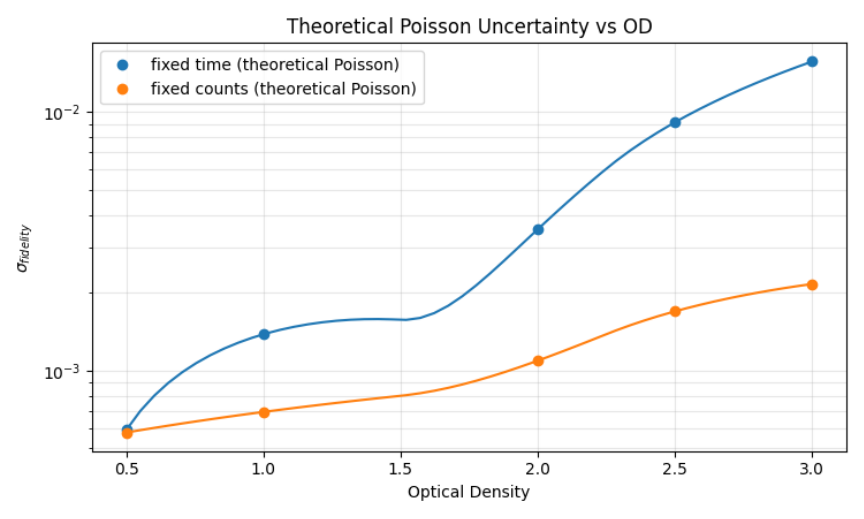
Uncertainty in QST is known to scale like 1/√N, where N is the number of photon detections. This relationship is usually treated as if N alone determines fidelity, regardless of how those photons are collected over time.
Goal
We seek to investigate whether photons detections per unit time (i.e. photon flux is a more defining feature than simply the total number of photons detected.
Outcome
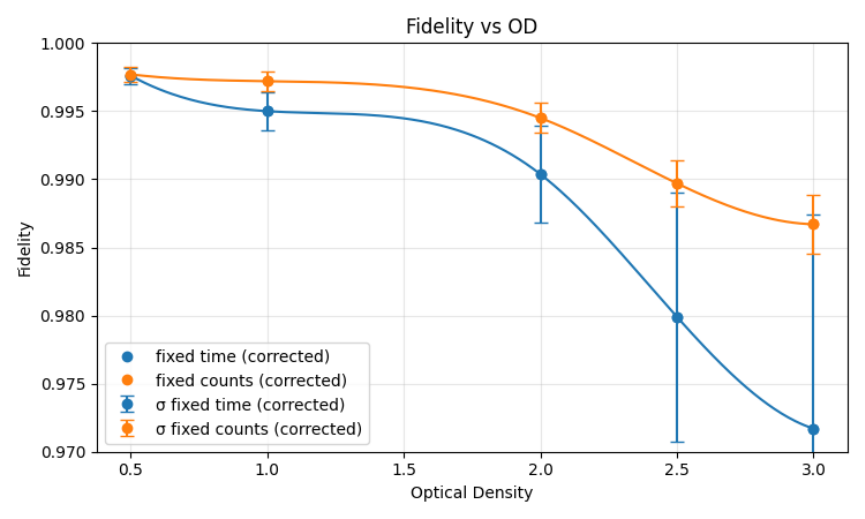
We can confidently see a much lower fidelity and higher uncertainty associated with trials that had a fixed time instead of fixed counts. We can thus conclude that photon flux has a less defining feature than the total number of photons detected in a fidelity of these systems.